This blog is mostly about teaching and learning English. I am a teacher educator in Singapore and I write for teachers, parents and anyone else interested in English education particularly at the primary school level.

Sometimes I have the urge to write about stuff from my everyday life and tell stories from my childhood. I often give in to these urges. Nobody has to read everything here. But as Lionel Shriver once wrote,
" Untold stories didn't seem quite to have happened."
Life does happen, so let the stories unfold...


Monday, September 12, 2011

Have we done enough?


Two weeks ago, I had to go to Tan Tock Seng Hospital for some tests since my recent mammogram showed some irregularities. I did not give this too much thought although it was yet another unwelcome piece of news that I had had that week. I turned up at the clinic armed with a book, a sweater and a water bottle and was prepared for a long wait. The clinic was full, and again, I was reminded that breast cancer can happen to any woman.  Then the request came for me to do a second mammogram.  After that, I had hoped for the best. So I was not eager to respond to the next request for an ultra sound. It was while lying on the bed with cold gel all over my chest that I started to ask myself if there was anything I could have done to avoid this situation. I must confess to getting nervous at that stage especially when the nurse had to call me back for a second ultra sound after I had changed back into my clothes.   After some reflection, I realised that there was nothing more I could have done.  I have faithfully gone for mammograms once every two years, exercised, minded my diet, and done enough I think without becoming paranoid. And there is no history of cancer in my family. Finally, to cut a long story short, I found out that while there was an increase in the calcifications, these were not cancerous.

After that incident, I got busy working on a seminar for my PSLE students. I wanted to make sure that my teachers have prepared the students well. But as I busied myself, I started thinking about the parallels between my experience at the hospital and preparing students for exams. The PSLE is around the corner, and I know that after that, we would often ask ourselves if we had done enough to prepare our students for it.  Did I teach them that? Did I remember to revise that with them? Could I have taught that skill/item more efficiently so that they will get it right? It’s exactly like what I did, asking myself, if I did I enough to ensure  that I won’t get breast cancer.

Well, I think  there’s no point asking those questions because asking them means that we think we can cover all bases for the exams.  Just like life, we can’t take care of every single thing in an exam.   If we can predict everything, then we are either gods or the exams are a sham. In English especially, it is difficult to say how well a child will do. I, like many teachers, often fall into the trap of saying one can get an A* this way or that way but the truth is, a lot depends on the child, other children, the day, the test and a whole host of other factors.  Language tests are also not objective, although this does not mean that they are always scored subjectively.  A child who fails to get the A* he or she deserves can still go on in life and succeed.  A child who scores A* and hates the subject will end his or her learning of the subject after the exam.

My son, Junior, is one example. He struggled with Chinese all through his school career.  But not passing Chinese at PSLE and not offering Chinese as an exam subject in secondary school did not stop him from learning it.  Now at 21, he travels to Taiwan often to meet his business associates and no one speaks English there. Junior has to speak Mandarin and also to learn some technical terms related to his products. I am only thankful that although he was weak in Mandarin at school, he did not leave school with a negative attitude towards it. He can still learn the language now.  These days, he even speaks Mandarin in Singapore when he has to.  Could I have done more to help him with Chinese? I don’t know.  But I know I tried my best.

So if you are worried stiff now about the coming exams, don’t add to your stress by asking, Am I doing enough?, or  after the exams,  Did I do enough? Ask instead if you did all you can and if you did it with the right intention.  You can only do that much; the rest is beyond you. 

As for me, I am returning to my usual life style. I reckon I am doing enough and I should instead learn to enjoy my life more, instead of worrying about things I have no control over. 

Thursday, September 1, 2011

Happy Teachers' Day and Some Prizes to be Won


                                                      Win one of these 2 T-shirts!

It's Teachers' Day again and if one is cynical, one can just treat it as a day for catching up on marking, completing administrative chores or setting exam papers. But wait! Why do that? If we have a day to call it our own, we should celebrate it. After all, how many professionals have a day to call their own? And when I say celebrate it, I don't mean go shopping.

We should celebrate it by reflecting on what makes us special. Yes, we are special, and I am sorry that nowadays, many people try to take that away from us. I say, don't let them. Instead, affirm our work. Take time off today and sit quietly for a while and reflect on why you are a teacher and what you want to do as a teacher. Think of the 40 faces you are in charge of every day and project ahead and imagine them ten years down the road. How can you make that road easier for them? Like it or not, they are your family, and your desire to do your best for them makes you special. Some, among the 40, won't have another person who will want to do that for them. You are super special to them.

At Teachers' Day lunch today, I asked some of my young teachers what makes teaching special for them. A young male teacher told me this without even pausing to think.

You get to watch your kids grow up, over and over again through the years. You don't feel you have to let your kids go, as parents do when their children grow up. For teachers, the gap is filled up almost immediately by a new batch of pupils.

Other responses include:


  • Teaching helps you keep in touch with things and you rediscover your youth always through teaching your pupils.
  • Teaching helps you stay alert to things in the world.
  • Teaching is a job that allows one to witness the turning point that can suddenly transform your kids. Granted, this does not happen to all kids, but when it does happen, you, the teacher, are there to witness it.
  • Teaching keeps one honest as it's difficult not to be honest with kids around you.

And there could be many more meaningful reasons like these.

Why do you teach and what meaning do you find in the profession? Send me a short paragraph or post it on my Facebook account. The most interesting responses/stories will win prizes! Two T-shirts that you see in the pictures here and I am happy to give away copies of my books, The Learning Teacher 1 &2 to other good submissions. All entries must be in by 11 September. Either post them here as Comments or on my Facebook account. Or email them to learning@pacific.net.sg.

No energy to write? Enjoy this video instead.

 http://www.heartofateachermovie.com/

Happy Teachers' Day again and Happy Holidays.

Friday, August 12, 2011

Seoul and Dog Poo


Two weeks ago, I was on a lightning trip to Seoul to visit a writing camp organised by the Bay Area Writing Project (BAWP). I have known about the BAWP from my postgraduate days at UC Berkeley and was keen to see what programmes they were offering. Unfortunately, I landed in Seoul on the morning of the storm-of-the-century and was caught in a four-hour traffic jam getting to the hotel.  Our very resourceful taxi-driver worked hard, taking every short cut he could think of. Otherwise, we could have been in the jam for a much longer period. With no English newspapers, it took me a day or more before I discovered the extent of damage in Seoul from the rains that fateful day.

Our three-day trip was spent in the camp and during our free time, we were in a mall to escape the rain. Sadly, I am in no position to say much about Seoul from this trip. But I was most impressed by Incheon airport and learnt a bit more about the art of kimchee making.


                                 A "royal" procession at Incheon airport, staged to entertain tourists.

Back home, I spent the Sunday attending the Buddhism and Science Symposium, where experts spoke about the link between scientific research and Buddhist practices like meditation.  Here are some of the ideas I took away from that day:

1. The map is not the territory. Our perception of the world is just that- a perception, and not the real thing. We should not use our perceptions of people and of the world to measure or judge people or events because ours is only one view.  A timely reminder.

2. Life is not about being good. It’s about being real. CG Jung.

3. We have 5 dreams per night and 1825 per year. We all dream but each dream is unique and particular to the dreamer.

4. Here’s an exercise that Dr Marke Greene suggested. Try it.
      Close your eyes. Imagine a person who is very difficult. Choose someone of the same gender. Think of a word that describes what makes this person difficult.
Chances are that the word you chose to describe the person also describes you. I tried this and it took me a while to understand and accept that the word also described me. That was humbling and enlightening.

      5. The Ven Chuan Guan gave a lively talk during which he told a story about dog poo. Here’s a paraphrase of what he said: When we are out and about, and we step on dog poo, what do we do? We try to get rid of it immediately, either by wiping our shoes on some grass or with tissue. We don’t pick the dog poo up, put it in a bag and tie it up neatly to take it home. And when we get home, and we are asked what we did outside, we don’t take our pack of dog poo out, unpack it and share it with our family. Nor do our family members share the dog poo they've inadvertently stepped on with us. 

The Venerable’s message is this: Don’t take home your emotional dog poo and share it with your loved ones. Leave the dog poo outside where it belongs. Making your loved ones deal with your dog poo is not a loving gesture. 

I thought this was an interesting metaphor and a good story to share with everyone. Like itor not, we are all a little guilty of unloading dog poo on our loved ones every now and then when we get home from a stressful day at work. Perhaps it’s time to rethink this habit.

So, it was a Sunday well spent and after that I had a week of work and fought the flu at the same time.  National Day came and went.  At one point, it was bad enough for me to cancel yoga and all physical exercises and although work went on as usual, I never really got better. Today, I still have a bad cough after having consumed a whole bottle of cough syrup.  Ah well.  Thank goodness it’s Friday! 

Four Steps to Staying Sane as a Teacher

This is the time of year when teachers go a bit crazy with stress and work. Perhaps it's a good time to take a bit of time over the weekend and read this article about staying sane.

Four Steps to Staying Sane as a Teacher

Friday, July 15, 2011

Narrative feedback

Recently, an American educator told me that she heard from a friend who taught here in a premier junior college that Singaporean teachers don't care to give feedback when they mark. They are only concerned with grammatical mistakes, he said.

I don't know if that's true of the whole system, but in the primary schools and to a large extent the secondary schools, marks are what count for teachers, students and parents. This is sad because a mark does not tell us enough what is good or not so good about a piece of writing. And if teachers say it's easier to give a mark than comments, I would beg to differ. Have we not, at one time or another, been caught in this great dilemma of how many marks to give? 5, 5.5 or 6? And what is the difference between these marks?

It is really time to give more attention to giving quality feedback instead of marks. Watch this video about narrative feedback, which is more than just giving comments, and see if there's a way we can adopt this idea for our marking.

How narrative feedback can crush the ABCs - South Euclid, OH, United States, ASCD EDge Blog post

Monday, July 11, 2011

Walking down the tracks of time


In the late 1970s, I was one of the many Malaysians who came to Singapore in search of a new life. Like many of them, I too came by train through the Tanjong Pagar Railway Station. So when it closed recently, I did feel a sense of regret.

In those days, I travelled by train frequently and although I did sometimes drive, my husband felt it was safer for me to travel by train, especially when I was travelling alone. My family and friends came to visit me by train and I still remember the anxiety and the excitement among the waiting crowd when the train appeared around the corner, very often behind schedule. Going home was another anxious event especially getting past the less-than-friendly Malaysian customs officers. But still, taking the train was better than the bus in those days when luxury coaches and superhighways were non-existent. 

But from way back in my childhood, trains were a part of my life. I went to school in Sentul which was where the largest railway workshop in Malaysia was situated. The railway track was about 300 metres behind my house and I spent a lot of time playing on the tracks. On school days, I’d walk to and from school with Roziah Sultan, my best friend then, and part of the journey was along the railway track. The nicest part about the walk was the railway creepers with their lovely pink flowers.  Some days, the train would pass, and we would wait behind the railway gates, staring up at the people in the train and wondering where they were going.

When I started travelling to university, I was able to take the commuter train from a train stop behind my house to the main railway station in town where I caught a bus to the campus in Pantai Valley. Near my home, a road, Ipoh Road, crosses the railway line creating a tunnel below. My brother and his Boy Brigade friends spent many a weekend practising their bugle playing in that tunnel. They weren’t the finest musicians so the tunnel was the best place to practise improving their lung power.  Not far from this tunnel was a railway bridge which spanned the Batu River. My siblings and I spent many a mischievous day there, crossing the river on the railway track. That was not really a safe thing to do; one misstep and we would be in the fast flowing waters of the river, but we were young and foolish then. Sometimes a train would appear unexpectedly and we would have to step off the track and cling on to the side of the bridge while the train roared past us.  When there was no train, we would practise balancing on the tracks (pretending to be ballerinas or tightrope walkers) and pick wild rhododendrons and grass flowers for our home.  On the odd occasion when the neighbourhood crazy man appeared on the track, exposing various parts of his emaciated body, we would throw stones at him. I don’t ever remember being afraid of anyone or anything in those days.

Today the railway workshop has been replaced by The Kuala Lumpur Performing Arts Centre (KLPac) and Sentul West looks a lot like Singapore with its Singapore-styled condominiums. The old golf course, built for the managerial and administrative staff of the railway workshop, is still there but that part of Sentul is no longer the working class neighbourhood it used to be. Our family home has gone too but my sister still lives nearby and the trains run a road away past the front of her house. The railway track is now electrified and fenced up. Whenever I visit my sister, I still hear trains roaring past at odd hours of the day and night.

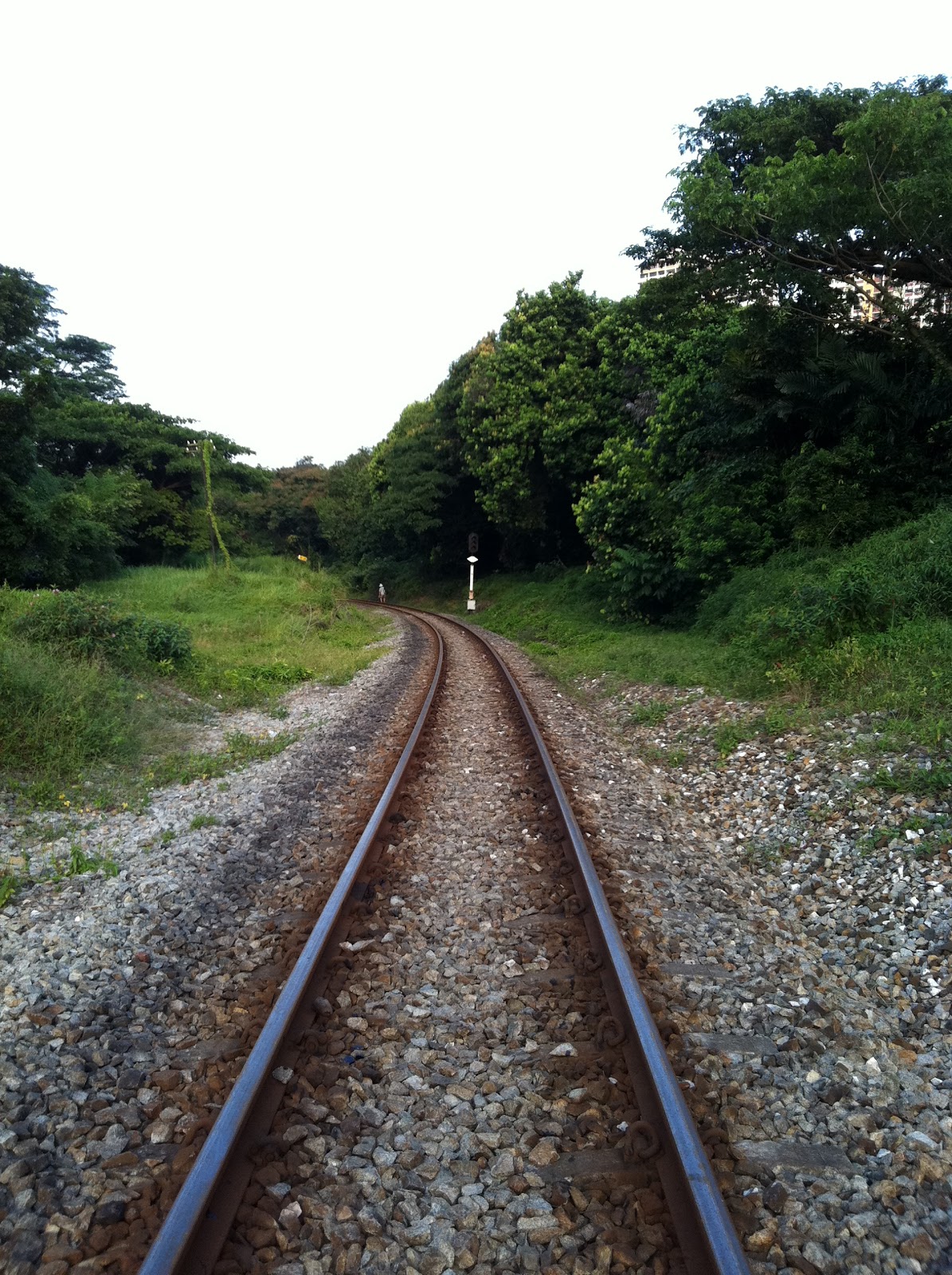
I was recalling these and other events from my childhood when I took a walk with my husband along the old railway track from Silat Walk to Bukit Merah Central last week. The walk brought back many memories; a railway track is somewhat the same no matter which country we are in. Here are some photos from our walk.


We began at Silat Walk and many people were already there, taking pictures and just looking around. 


The track into the station has been cordoned off already so we could only walk westwards.


One of the several bridges we went under. Many glue sniffers frequented these places judging from the empty tubes and tins.


A sign reminding train drivers to check their brakes. Good to know that they take their job seriously.


Wild rhododendrons and other wildflowers along the track.


Making a “phone call”.


There was even a romantic message!


The sun was shining in my eyes as we walked westwards, but when I lifted my eyes and looked out from under the brim of my Tilly hat, I saw an amazing sight- sunlight shining on some grass flowers, turning them into bouquets of burnished gold. Wordsworth can keep his daffodils! This was so breathtaking.

We should all support the proposal to turn this railway line into a green rail corridor. It will be a wonderful place for the young to explore and to enjoy.